

⚠️ Affiliate Disclosure: BuyCycleWorld.com is a participant in the Amazon Associates Programme, an affiliate advertising programme designed to provide a means for sites to earn advertising fees by advertising and linking to Amazon.co.uk. When you click our links and make a purchase, we may earn a small commission at no extra cost to you. This helps us keep the site running and the reviews coming. We only recommend products we genuinely believe in.
The JoeBlow Sport III has been a benchmark floor pump for over a decade, and the current version refines the formula without departing from it. The 360-degree rotatable base provides stability on any floor orientation, and the TwinHead valve chuck handles both Presta and Schrader without swapping adaptors. The 2.5-inch gauge is easy to read and accurate. At around 160psi maximum pressure it handles road tyres, mountain bikes, and tubeless setups with equal capability. One of the best value propositions in workshop tools.
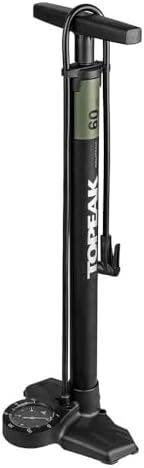
- HEAD: SmartHead with long hose
- BARREL: Painted steel; GAUGE: 60 psi or 4 bar, 3.5” base mount analog
- VOLUME PER STROKE: 683 cc
Lezyne Steel Floor Drive
Lezyne built the Steel Floor Drive around premium materials and precise engineering, and the result is a pump that feels significantly more refined than its price suggests. The steel barrel is machined rather than cast, producing a smoother piston action with less effort per stroke. The ABS gauge is accurate and reads cleanly from standing position. The over-moulded base is stable and scratch-resistant on workshop floors. This is the pump cyclists tend to keep for many years.
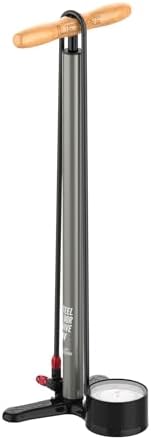
- TOP-QUALITY BIKE PUMP – The Steel HV Floor Drive 3.5 from Lezyne is a high-end bicycle floor pump designed for fast, hig…
- HIGH VOLUME – This Lezyne bike pump with gauge is engineered for precise, high-volume inflation and is capable of reachi…
- ANALOG GAUGE – The Steel Floor Drive 3.5 bike tire pump features an extremely accurate easy-to-read 3.5-inch gauge (100p…
Silca Pista Plus Floor Pump
Silca pumps are to cycling what a quality Leatherman is to multi-tools: heirloom-grade tools that can be rebuilt and serviced indefinitely. The Pista Plus uses a hand-stitched leather pump head seal that outperforms synthetic alternatives in both longevity and pumping efficiency — the leather expands under pressure to create an increasingly effective seal rather than the degrading-over-time performance of rubber. The solid brass and chrome-moly steel construction is visually extraordinary and practically indestructible. This is the last floor pump most cyclists will ever buy.
- HEAD: SmartHead with long hose
- BARREL: Painted steel; GAUGE: 60 psi or 4 bar, 3.5” base mount analog
- VOLUME PER STROKE: 683 cc
Bontrager Flash Charger Road Pump
The Flash Charger is built around a specific problem: tubeless tyre seating. Tubeless tyres require a sudden, high-volume blast of air to seat the bead against the rim rather than the gradual build of conventional tube fitting. The Flash Charger’s integrated pressure chamber accumulates air from slow pumping strokes, then releases the accumulated pressure in a controlled blast that seats tubeless beads reliably without a compressor. For cyclists running tubeless road or gravel tyres, this pump removes the most frustrating aspect of the setup process.

- DUAL-VALVE BICYCLE PUMP – Our dual-valve bike pump is designed to quickly inflate both Presta and Schrader valves, ensur…
- DURABLE CONSTRUCTION – This bicycle pump features a sturdy 35mm aluminium alloy barrel with a plastic base, providing re…
- WIDE USE – The bike floor pump offers versatile inflation capabilities, suitable for BMX, mountain, road, and commuter b…
Zefal Profil Max FC80 Floor Pump
Zefal’s Profil Max offers French engineering at a practical price point. The dual-function gauge reads psi and bar simultaneously, the composite barrel reduces weight without sacrificing durability, and the large-diameter dual-action head operates on both the push and pull strokes for faster inflation. The comfortable T-bar handle distributes pumping force across the palm rather than concentrating on a narrow grip. A daily-use pump that delivers well beyond its cost.

Oxford Fatboy Pump
The Oxford Fatboy is optimised for mountain bike and fat bike tyres — its high-volume barrel moves significant air per stroke for filling large-volume tyres to low pressures quickly. The accuracy at low pressures (15–35psi MTB range) is better than most pumps designed primarily for road use. For cyclists who run multiple bikes and need a pump that handles both extremes of tyre volume, the Fatboy covers the mountain end while most road pumps handle the other.

- 15″ Plastic Pump
- Fits both presta & schrader
- Pump carry clips included
Buying Guide
Maximum pressure capacity matters for road cyclists: tyres run at 80–120psi require a pump rated to at least 160psi to maintain accurate gauge readings through the final strokes. Gauge accuracy is often overlooked but critically important for tubeless setups where under-inflation causes burping and over-inflation can blow beads. Look for gauges with at least 2.5-inch diameter and clear demarcation at road-relevant pressures. Valve chuck design determines how smoothly the pump engages and releases — a good chuck locks positively on both Presta and Schrader and releases cleanly without air loss. Pumps intended for tubeless use should specify tubeless compatibility, as the air volume and initial blast requirement differs from tubed setups.
🚴 Related Reading
A floor pump is used before every ride and after every flat repair — invest in one that earns its place in the workshop. The Topeak JoeBlow Sport III delivers reliable performance at a sensible price and has served countless cyclists without complaint. For those who view workshop tools as lifetime investments, the Silca Pista Plus is the only pump in the cycling world that can genuinely be described as heirloom quality.
Buying Guide
Floor pumps (track pumps) are the essential workshop tool for maintaining correct tyre pressure before every ride. They inflate tyres far faster and more precisely than mini pumps, with accurate pressure gauges and ergonomic handles designed for sustained pumping. Every cyclist with a home workshop should own one.
| Factor | What to Look For |
|---|---|
| Pressure gauge accuracy | Look for a gauge accurate to ±2 psi minimum. Dial gauges on quality pumps (Silca, Topeak, Lezyne) are more accurate than cheap bourdon tube gauges. Some higher-end pumps include digital gauges for precision to ±1 psi. |
| Maximum pressure | Road and track cycling requires 100–130 psi. MTB tyres run 20–35 psi. All floor pumps reach MTB pressures easily; ensure the pump is rated for your road tyre target pressure. Most quality pumps reach 160 psi+. |
| Head type | A dual-head that fits both Presta and Schrader without adapters is the most versatile. Look for a locking lever head — threaded-on heads are slower to use and can strip Presta valve cores. |
| Hose length | A longer hose (60cm+) allows you to pump comfortably without crouching. Rubber hoses are more flexible in cold weather; reinforced hoses resist kinking during rapid pumping. |
| Barrel material | Aluminium or steel barrels are more durable than plastic and deliver more air per stroke. Avoid pumps with thin plastic barrels — they crack and leak over time, particularly at the base. |