
⚠️ Affiliate Disclosure: BuyCycleWorld.com is a participant in the Amazon Associates Programme, an affiliate advertising programme designed to provide a means for sites to earn advertising fees by advertising and linking to Amazon.co.uk. When you click our links and make a purchase, we may earn a small commission at no extra cost to you. This helps us keep the site running and the reviews coming. We only recommend products we genuinely believe in.
The Micro Floor Drive is categorically the best high-pressure mini pump on the market and has held that position for years. The foldable foot and T-shaped handle convert what is a compact cylinder into a functional floor pump for roadside use — you can stand on the foot and pump with both hands, achieving 160psi in a road tyre without the wrist fatigue that conventional mini pumps cause. The ABS valve head switches between Presta and Schrader without tools. A genuine engineering achievement at this size.
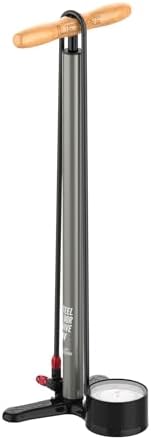
- TOP-QUALITY BIKE PUMP – The Steel HV Floor Drive 3.5 from Lezyne is a high-end bicycle floor pump designed for fast, hig…
- HIGH VOLUME – This Lezyne bike pump with gauge is engineered for precise, high-volume inflation and is capable of reachi…
- ANALOG GAUGE – The Steel Floor Drive 3.5 bike tire pump features an extremely accurate easy-to-read 3.5-inch gauge (100p…
Topeak Turbo Morph G
The Turbo Morph G uses the same floor pump conversion concept with a flexible hose between pump and valve head. The hose prevents the pump from stressing the valve stem when pumping at high pressure — a common cause of valve damage with direct-attach pumps. The gauge reads to 160psi for precise inflation. At around 230g it is among the heavier mini pumps but the pumping experience is closer to a floor pump than any competing product.

- Topeak Morph Turbo Bicycle Tyre Pump with Flip Down Analogue Pressure Gauge
- Versatile mini pump suitable for MTB, Road and Gravel bikes; Body is made from light weight butted aluminium so the pump…
- Features a top mounted flip down analogue pressure gauge for accuarte tyre inflation as well as an integrated fold out f…
Lezyne Sport Drive HV
The Sport Drive HV (High Volume) is optimised for mountain bike tyres rather than road tyres. The wider barrel diameter moves significantly more air per stroke, meaning fewer strokes to fill a 27.5 × 2.4 tyre to trail pressure. It will also inflate road tyres to around 90psi — adequate for getting home, if not for racing. The ABS2 valve head is reliable and compatible, and the alloy body feels robust enough to survive a season in a jersey pocket.

Crankbrothers Gem Short Pump
Crankbrothers approach the mini pump challenge with a focus on minimal size. The Gem Short is genuinely pocketable — 145mm closed — and achieves 120psi for road tyres with a reasonable effort per stroke. The dual-direction valve is the slickest mechanism in this category: the valve head clicks onto both Presta and Schrader valves without requiring position switching or swapping of parts. For cyclists who want the smallest possible pump that still does the job, the Gem Short is the answer.

- Large, accurate digital gauge pumps up to 160 psi / 11 bar
- Hidden hose fits into the body of the floor pump and is held magnetically
- Quick connect for gauge to be mounted to pump
Topeak Mountain DA G Frame Pump
Frame pumps mount to the bicycle frame using the cage bosses, leaving jersey pockets and saddle bags unoccupied. The Mountain DA G fits most frame triangles from 40cm to 58cm and includes a dual-action mechanism that pumps on both the push and pull stroke — delivering air twice as fast as single-action alternatives. The gauge reads to 160psi and the flexible hose protects valve stems from lateral stress. The best frame pump for cyclists who want no compromise on pump performance and can tolerate the frame mounting aesthetic.

- Topeak Mini Morph Bicycle Tyre Pump
- Versatile mini pump suitable for MTB, Road and Gravel bikes; Body is made from light weight aluminium so the pump only w…
- Features an integrated fold out foot to help keep the pump steady whilst pumping
Specialized Air Tool Comp Mini Pump
Specialized’s Air Tool Comp hits a reliable middle ground: not the lightest, not the most compact, but consistently rated by cyclists for ease of use and achievable pressure across a broad range of tyre types. The T-bar handle provides comfortable two-hand pumping, and the rubber valve chuck locks securely to prevent accidental disengagement mid-pump — a source of significant frustration with cheaper alternatives. At around 130g it is reasonable for daily carry.
- Topeak Mini Morph Bicycle Tyre Pump
- Versatile mini pump suitable for MTB, Road and Gravel bikes; Body is made from light weight aluminium so the pump only w…
- Features an integrated fold out foot to help keep the pump steady whilst pumping
Airbone ZT-702 Mini Pump
The Airbone ZT-702 is a legend in the cycling community for delivering honest performance at the lowest price point in quality mini pumps. At around 85g it is one of the lightest pumps available, and it achieves 100psi for road tyres with persistent effort. The build quality is not as refined as Lezyne or Topeak alternatives, but it works every time. For commuters who want a reliable backup pump without spending more than is necessary, the Airbone is the sensible choice.

Buying Guide
For road cyclists, the priority in a portable pump is achievable pressure — road tyres typically run at 80–120psi and a pump that cannot reach that range is useful only for limping home slowly. The floor pump conversion feature of the Lezyne Micro Floor Drive and Topeak Turbo Morph fundamentally changes the pumping experience by allowing a proper stance and two-handed operation rather than the awkward balancing act of a standard mini pump. For mountain bikes, volume per stroke matters more than maximum pressure — trail tyres at 25–35psi need a lot of air moved to fill the larger volume. Valve compatibility is a basic requirement that surprisingly many budget pumps get wrong — the best pumps handle both Presta and Schrader without tools or separate adaptors.
🚴 Related Reading
A good portable pump is the insurance policy you hope never to use but are profoundly grateful for when you do. The Lezyne Micro Floor Drive remains the definitive high-pressure mini pump — it converts roadside inflation from a struggle into a routine task. Mountain bikers and tourers who need volume over pressure should look at the frame pump format, where the Topeak Mountain DA G delivers professional-level pumping with the convenience of bike mounting.
Buying Guide
Portable bike pumps — mini pumps and frame pumps — provide emergency inflation for roadside punctures. Unlike CO2 inflators, they are reusable and never run out. The best portable pumps balance compactness for jersey pocket or frame carry with enough efficiency to reach usable tyre pressure without excessive effort.
| Factor | What to Look For |
|---|---|
| Valve compatibility | All pumps should fit both Presta and Schrader valves. Many road bike pumps default to Presta-only — check before buying if your bike uses Schrader valves (common on MTB and older hybrids). |
| Maximum pressure | Road tyres need 80–110 psi; gravel tyres 40–60 psi; MTB tyres 20–35 psi. Most mini pumps reach 80–100 psi with effort; frame pumps reach 100–120 psi more efficiently. Check the rated maximum against your typical tyre pressure. |
| Pump efficiency | Measured in cc per stroke (volume of air moved). Higher cc/stroke means fewer strokes to inflate — less effort and faster roadside repair. Frame pumps are more efficient than mini pumps; any pump claiming over 3cc/stroke is above average. |
| Size and weight | Mini pumps: 15–25cm, 60–100g — fits jersey pocket. Frame pumps: 40–60cm, 100–200g — mounts to frame. Larger is more efficient but less packable. Choose based on how much jersey pocket space or frame mount space you have. |
| Pressure gauge | An integrated pressure gauge is a genuine advantage for setting precise tyre pressures roadside, particularly for tubeless setups where exact pressure matters. Reduces the need to guess at inflation level. |